
I Miss The Old Google Chrome

I miss the days when Chrome felt like a window onto the Web.

Google Chrome was my favorite browser for a long time, almost since it first was released.

I wasn’t just buying into the Google fanclub, or at least I want to believe it was more than that. What I saw in Chrome was something that I felt was exactly right in the world where I saw the web growing more powerful and able every day.

At one point I recall saying that Firefox was about how much the browser can be for you, while Chrome was about how it can get out of your way and expose the web itself as directly and cleanly as possible.

I was behind this idea of a window into the web full heartedly because I thought it was the best way to promote everything the web could be.

How much has this changed?

Today, I’m not sure if the situation has reversed, but I am certain that my old view of Chrome is no longer something I can stand behind. Chrome has changed a lot and shifts further from its roots as a neutral arbiter of a clean web. Sadly, I don’t suspect this is going to change.

At one point Chrome represented a pure web, which is important because we need a voice that affirms the web is a worthy goal on its own.

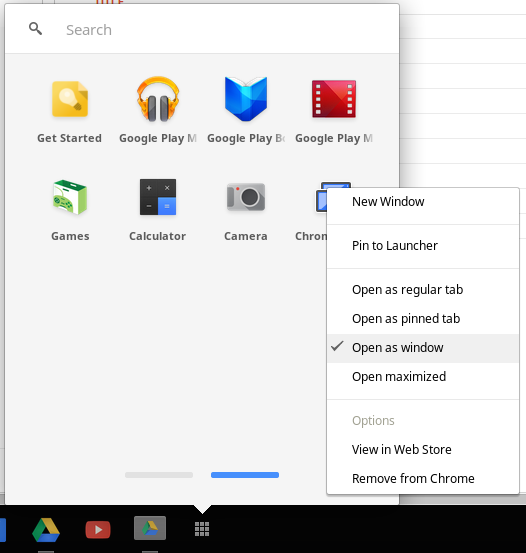
This is no longer the feeling you get when looking at Chrome with the host of “Chrome Apps” ready to be installed, built from a platform that was born of the web, but walks its own line. Chrome has different classes of app-citizens, web apps and Chrome apps, and this is a drastic departure from its earlier days when it took those pure web applications and thrust them into the desktop kicking and screaming. I remembered how excited and happy I was to click that “Open as Window” option among the applications that were really nothing more than a bookmark. Suddenly, thousands of amazing web apps became near-first-class citizens that sat right beside my native applications.

I was sure that I was given a peek into the future.
Screenshot+2013-04-16+at+12.25.14+PM.png

Maybe it was inevitable. Embrace, Extend, Extinguish is the mantra that seems to drive Google product decisions. They play the game well.

I’m not saying Chrome apps aren’t a nice thing. I’m not saying they aren’t without merit. But Google made a very calculated and deliberate decision to sunset their support for pure web apps to push their own platform. Browsers always have new APIs that are experimental or that they’ve implemented from a standard first, but Chrome apps don’t represent even that illusion of playing nice. Even Microsoft is doing better with this for the last several releases of Internet Explorer.

It was a nice ride, Chrome, but I don’t think you can be my browser anymore.

Comments

garylinux said…
Does Chromium do what you want? It has not made all the changes that chrome has. Rekonq Is also a decent webkit browser.

Popular posts from this blog

My Software Job Transition Strategies?

I’ve been spending a good deal of the last two days preparing mentally for starting a whole new challenge as a developer. New things aren’t new to me, but this is different and big enough really call for some Deep Thoughts ™. For one thing, I’ve made a big move from the world of Python web development to totally other Python work and while web development has never been the only thing I do, it has been the only work that paid the bills. That transition isn’t one that bothers me or daunts me, though. Instead, I’m thinking about transitioning to the scope of the work I’m getting into. For a long time, I juggled multiple clients and client projects every day, so no single project usually took up most of my time. Every developer juggles time through the day, but exactly how that works in each company and on each project varies a lot. I was looking for a place that I could really focus in a way that I haven’t for a long time. I think I found that, but now I have to deal with the consequen...

CARDIAC: The Cardboard Computer

I am just so excited about this. CARDIAC. The Cardboard Computer. How cool is that? This piece of history is amazing and better than that: it is extremely accessible. This fantastic design was built in 1969 by David Hagelbarger at Bell Labs to explain what computers were to those who would otherwise have no exposure to them. Miraculously, the CARDIAC (CARDboard Interactive Aid to Computation) was able to actually function as a slow and rudimentary computer.  One of the most fascinating aspects of this gem is that at the time of its publication the scope it was able to demonstrate was actually useful in explaining what a computer was. Could you imagine trying to explain computers today with anything close to the CARDIAC? It had 100 memory locations and only ten instructions. The memory held signed 3-digit numbers (-999 through 999) and instructions could be encoded such that the first digit was the instruction and the second two digits were the address of memory to operat...

The Snake Pit is About to Burst

The signs are all over the place. I can count at least five implementations of Python today: CPython, CL-Python, Jython, IronPython, and PyPy. The use of the language is sky rocketting and set to grab real mind-share as the hype over Ruby subsides. Things are looking good for a favorite green snake and british comedy troop reference, aren't they? Trouble is on the horizon in the very ingredients that could push us into true success. Our community and our very language is in danger of segregation, unless we all do something about it and learn to get along. One of the most visible dangers (to me) is being ignored for various political, cultural, and non-technical reasons. IronPython's users are increasingly pushing IronPython-only recipes, libraries, and tutorials. No one is talking about the transition of the alternative implemenations to CPython 3.0 compatability. To make matters worse, we still can not define the language without refering to an implementation. This is very un...